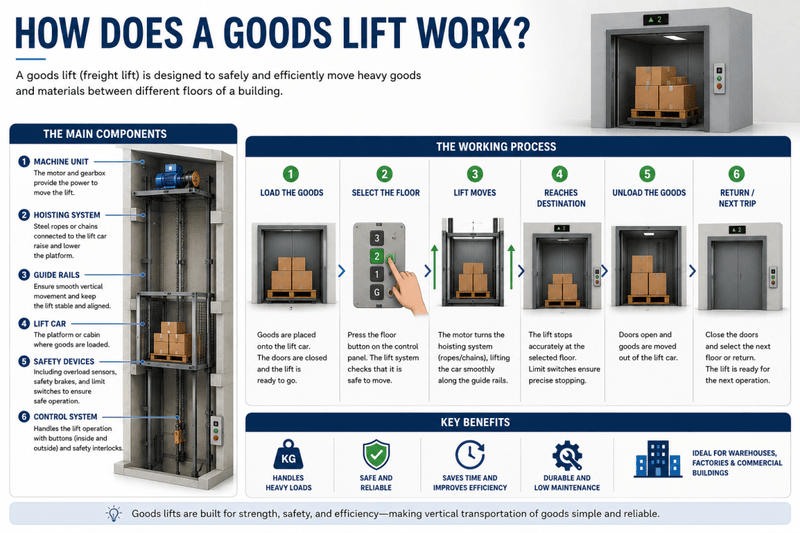
A goods lift is a vertical transportation system designed to move goods, equipment, pallets, raw material, and heavy loads from one level of a building to another.
Unlike passenger lifts, goods lifts are engineered for industrial duty cycles, heavier load capacities, stronger platforms, and practical safety controls. They are commonly installed in warehouses, factories, logistics centers, retail stores, hospitals, and commercial buildings where material movement between floors is frequent.
JOSMECH Equipments India Pvt. Ltd. manufactures material handling and lifting solutions for businesses that need dependable, efficient, and safe movement of goods. A well-designed goods lift can reduce manual handling, improve workflow, protect inventory, and support safer daily operations.
About Goods Lifts
Goods lifts replace slow and risky manual lifting by providing controlled vertical movement. They help lower labor effort, reduce product damage, and improve movement of raw materials, finished goods, machinery parts, cartons, and warehouse stock.
Modern goods lifts may use hydraulic, traction, or electromechanical systems. They can be customized by load capacity, platform size, lifting height, door type, control panel, safety features, and available installation space.
Types Of Goods Lifts
Hydraulic Goods Lift
Uses hydraulic cylinders and pressurized fluid for smooth, stable lifting. It is suitable for factories, warehouses, and medium-rise industrial applications.
Traction Goods Lift
Uses electric motors, ropes, and counterweight systems for efficient movement across multiple levels and frequent use cases.
Scissor Goods Lift
Uses a scissor mechanism for vertical lifting, often selected for loading bays, production areas, and material transfer points.
Mezzanine Goods Lift
Connects warehouse floors, mezzanine storage areas, and production levels for safe movement of inventory and packed goods.
How Does A Goods Lift Work?
A goods lift raises and lowers a platform or cabin through a powered lifting mechanism. Depending on the design, movement may be generated by hydraulic pressure, an electric motor, traction ropes, chains, or a scissor mechanism.
- The operator loads goods onto the lift platform.
- The control panel starts the lifting or lowering cycle.
- The drive system moves the platform to the selected level.
- Safety devices monitor overload, door position, platform alignment, and emergency stop conditions.
- Goods are unloaded safely at the destination floor.
Practical note: The best goods lift design depends on load capacity, lifting height, travel frequency, available space, and the type of material being moved.
Where Are Goods Lifts Used?
- Warehouses and distribution centers: Moving pallets, cartons, stock, and packaged goods between levels.
- Manufacturing plants: Transporting raw materials, machine parts, tools, and finished products.
- Logistics facilities: Improving loading, unloading, and dispatch movement speed.
- Retail stores and shopping malls: Moving stock from storage areas to sales floors.
- Pharmaceutical and food processing units: Safe movement of controlled, packed, or sensitive materials.
- Hospitals and commercial buildings: Transporting supplies, equipment, and maintenance material.
- Construction sites: Carrying tools, components, and building material across working heights.
Things To Check Before Choosing A Freight Lift
- Load capacity: Identify the maximum load the lift must carry regularly.
- Lifting height: Measure travel distance and number of floors accurately.
- Platform size: Match platform dimensions to pallets, trolleys, cartons, or machinery parts.
- Safety features: Look for overload protection, emergency stop, safety locks, and interlocked doors.
- Installation space: Review shaft, pit, headroom, and loading area requirements.
- Operating frequency: Choose a system suitable for your daily workload and duty cycle.
- Maintenance support: Select equipment with service access and reliable after-sales support.
- Customization: Confirm that controls, cabin size, doors, platform, and safety features can match your site.
Benefits Of Installing A Goods Lift
- Improves material handling efficiency and movement speed.
- Reduces manual labor and lifting-related workplace injuries.
- Supports better warehouse, factory, and stockroom productivity.
- Moves heavy goods more safely between floors.
- Reduces product damage during internal transport.
- Provides reliable long-term performance when maintained properly.
- Creates a stronger foundation for industrial automation and process flow.
Why Choose JOSMECH Equipments?
JOSMECH Equipments India Pvt. Ltd. focuses on durable, practical, and safety-led goods lift solutions for modern industrial requirements. The team supports custom design, robust fabrication, installation guidance, and dependable service for businesses that want stronger material movement systems.
For load capacity, platform size, lifting height, and site-specific recommendations, contact the team for a consultation and goods lift quotation.
FAQs About Goods Lifts
A goods lift is used for safely transporting goods, materials, pallets, and equipment between different floor levels.
Capacity can range from a few hundred kilograms to several tons depending on design, application, and site requirements.
Yes. Modern goods lifts include safety systems such as overload protection, door interlocks, emergency stop controls, and guided platform movement.
Yes. Goods lifts can be customized by capacity, platform size, travel height, door arrangement, controls, and operating environment.
A goods lift is designed for materials and heavy loads, while a passenger lift is designed and certified for transporting people.